There are seas in the Mediterranean that people call “nice”. And there are seas you look at and think someone made a mistake — this colour does not belong here, it belongs to a tropical island with palm trees and coral. The
journey to Sardinia is that experience.
But the Sardinia worth living is not only the Costa Smeralda of the famous and their yachts. It is the La Maddalena archipelago, with secluded coves that recall the Indian Ocean. It is Alghero, the medieval town with a Catalan soul. It is Corsica — the island you see across from the cliffs of Bonifacio, wondering why everyone doesn’t visit.
This guide covers both islands — because at this distance, the two together are far better than either on its own.
Why Sardinia and Corsica together — the “Emerald Passage”
The two islands are separated by the Strait of Bonifacio — just 12 kilometres of sea, enough to make them two entirely different countries, close enough to see both in one journey.
Sardinia is Italian at heart but entirely its own in character — it resembles no other Italian island. Corsica is French on paper but deeply Mediterranean in mindset, with wild nature, rocky coastlines and small towns that could have stepped out of another century.
The combined journey gives you something you cannot buy separately: the feeling of having crossed a sea route that few travellers take — returning with two entirely different experiences from a single trip.
Sardinia — beyond the clichés
Costa Smeralda: the fame and the reality
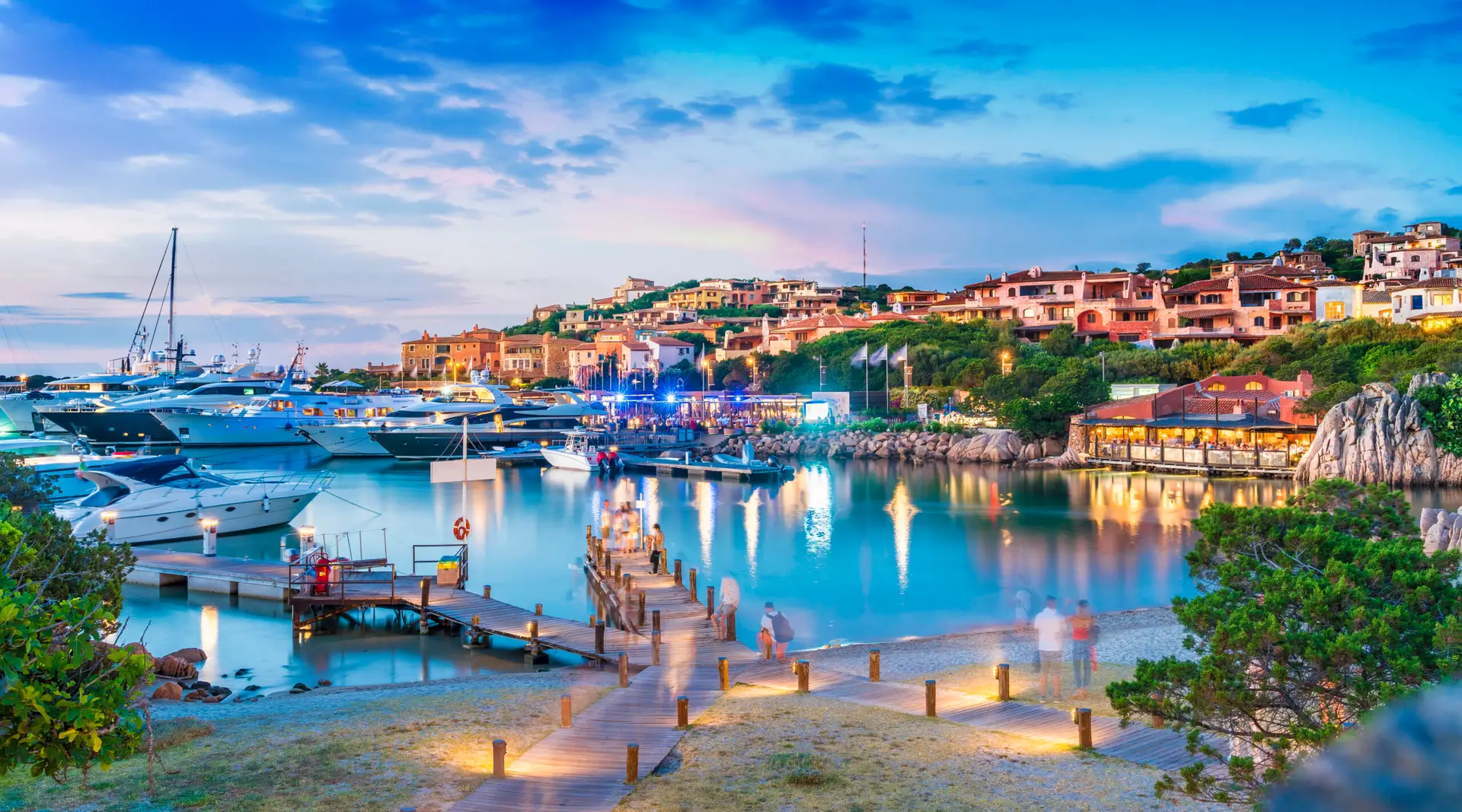
The Costa Smeralda was created almost from nothing in the 1960s by Prince Aga Khan IV, who chose this stretch of north-eastern Sardinian coastline to build one of the most exclusive resort destinations in the world. The result — Porto Cervo, Baia Sardinia, Cala di Volpe — is today one of the most recognisable landscapes in the Mediterranean.
But the Costa Smeralda is not only for those arriving by yacht. The waters are the same for everyone — an emerald that shifts shade with depth and light. The beaches — Capriccioli, Liscia Ruja, Grande Pevero — are freely accessible and among the most striking in Europe.
The La Maddalena archipelago: Sardinia’s secret
Seventeen islands and islets north-east of Sardinia, protected as a national park since 1994. Access is by boat only — and that is their greatest grace.
The main island, La Maddalena, has a town with cafés, restaurants and small hotels. But the reason you go is the coves you discover by boat: Cala Coticcio on Caprera — known as “Tahiti” to the locals — has waters that shift from turquoise to transparent within a few metres. There is no road to get there. That is the point.
Alghero: the most “un-Italian” town in Italy
In north-western Sardinia, Alghero still speaks Catalan — a legacy of the 14th century, when Aragonese Catalans seized and settled the island. The medieval walls face the Tyrrhenian, the narrow lanes hide churches and ossuaries, and the restaurants serve lobster in a way you will not find elsewhere in the Mediterranean.
Castelsardo: the town on the rock
Built on the crest of a rocky promontory overlooking the Gulf of Asinara, Castelsardo is one of those towns that look art-directed. Narrow cobbled lanes, a medieval castle at the top, women weaving traditional baskets in the doorways of their homes. A rare living tradition.
Corsica — the island you do not expect
Bonifacio: the town on the cliff
There is no approach to Bonifacio that does not leave you speechless. The old town — the Haute Ville — sits literally on the edge of white limestone cliffs plunging sheer into the sea. Below, caves and arches carved by millennia of erosion. Above, a view of Sardinia that looks close enough to touch.
The harbour beneath the cliffs is full of boats, sailing yachts moored beside super yachts. The restaurants serve friture de poulpe and charcuterie of Corsican cured meats. In the evening, the old town lights up in tavernas that have run unchanged for generations.
Porto-Vecchio and the beaches of the south
If the Costa Smeralda is Sardinia’s jewel, Porto-Vecchio is Corsica’s counterpart — with one difference: the beaches of southern Corsica, Palombaggia and Santa Giulia, have a wild naturalness that the Sardinian beaches, striking as they are, do not. Red rocks, pine forest running to the edge of the sand, waters that change colour ten times in ten metres.
When to travel — the honest guide
June: Ideal. The weather is reliably good, the sea warm, the crowds manageable. The best choice for beaches without queues.
July – early August: Peak season for the sea, but tourism is at its height. The Costa Smeralda in August is full of Italians on summer holiday — if that does not bother you, it is lively and festive. If you want quiet, avoid it.
September: The hidden month. The crowds have thinned, prices drop, and the sea is at its warmest of the year. The locals say Sardinia “becomes herself” in September.
May and October: For those who want sightseeing, history and food without a beach focus. The weather is pleasant, the sights empty.
Sardinian and Corsican cuisine: two islands, two complete gastronomies
Porceddu: Sardinia’s national dish — suckling pig slow-roasted over myrtle wood for hours. The myrtle lends an aroma found in no other Mediterranean dish.
Culurgiones: Handmade ravioli filled with potato, pecorino and mint, sealed in a shape like an ear of wheat. Every family has its own recipe.
Pecorino Sardo: The local cheese made from ewe’s milk. Young, it is soft and sweet. Aged, it turns intense and salty, perfect for grating.
Vermentino di Gallura: The white wine produced in north-eastern Sardinia — fresh, aromatic, ideal with seafood.
Corsican charcuterie: Lonzu, coppa, figatellu — cured meats from free-range pigs fed on acorns and chestnuts. The taste has nothing to do with industrial products.
Corsican brocciu: Fresh cheese from ewe’s or goat’s milk, used in desserts, pasta and starters. A protected designation of origin, found only in Corsica.
Why an organised journey makes the difference here
Sardinia and Corsica can be travelled independently — but the combined journey demands logistics that are not obvious: the ferry between the islands, luggage handling, hotels in two different countries, transfers in areas rental cars do not reach.
The boat excursion to La Maddalena cannot happen without a vessel — and choosing a boat in Sardinia is a matter of trust: how many people it takes, where it stops, whether there is snorkelling gear aboard, whether the skipper knows the hidden coves.
These details — the ones that separate a good journey from an exceptional one — are what a well-designed programme secures without you having to chase them yourself.
Our programme: The Emerald Passage — 8 days
We designed an 8-day journey covering both islands — the Costa Smeralda, La Maddalena, Alghero and Castelsardo in Sardinia, and Bonifacio in Corsica — with selected stays and a boat excursion through the archipelago.
See the full
programme and available dates.
Frequently asked questions about travelling to Sardinia
When is the best time to visit Sardinia?
June and September are the ideal months — good weather, warm sea and fewer people than August. September is especially underrated.
Do I need a visa for Sardinia and Corsica?
No. Both islands belong to EU countries — Sardinia to Italy, Corsica to France. An ID card is enough for EU citizens.
What makes Sardinia different from the Greek islands?
The colour of the sea, the scale of the coastline and the premium tourism infrastructure of the Costa Smeralda have no equivalent in Greece. At the same time, authentic Sardinian culture — the food, the history, the villages — is entirely different from anything you know in the Mediterranean.
How many days do you need for Sardinia and Corsica?
Eight days is the ideal time to see the highlights of both islands without rushing. Fewer than six days on a single island does not do the deeper experience justice.
Is the La Maddalena boat excursion included in the programme?
Yes — the boat excursion through the La Maddalena archipelago is one of the central experiences of the
Emerald Passage.
Is Sardinia an expensive destination?
It has a premium character, but the value is high: the quality of the sea, the food and the experiences justify the investment. Restaurant prices outside the Costa Smeralda are entirely reasonable.