
There are destinations that impress you. And there are destinations that change you.
The journey to Morocco belongs to the second category — but only if you travel it right. It is one of the few destinations where the difference between a good trip and a mediocre one is not the budget. It is the design.
This guide is everything I would tell you if we were sitting across from each other.
Why trust us with Morocco
It is not a given that a travel agency knows a destination simply because it sells it.
For Morocco, the numbers speak for themselves: according to data from Aegean, Genius Travel ranks among the top three Greek travel agencies in passenger traffic to Morocco.
We do not write this as a boast. We write it because it has practical consequences for your own journey: we know the hotels not from catalogues but from visits and repeated use; we have long-standing partners on the ground, not occasional suppliers; and we know what goes wrong and how it gets solved, because we have seen it before.
What you read below does not come from research. It comes from repeated presence.
Why Morocco is a premium destination — and why it is worth it
Many people believe Morocco is a cheap destination. And they are right — if you choose to travel it that way.
You can stay in simple lodgings, move around on local transport and eat on the street. It is an experience, and some people want exactly that.
We choose differently, and we spell it out because this is one of the few places where programmes genuinely differ from one another:
Casablanca, Marrakech, Fez — 5-star hotels. In the three major cities, where you spend most of your nights and where the difference shows.
Tangier and Ouarzazate — 4-star. One-night stops, with everything you need and nothing you don’t.
Merzouga — a kasbah right beside the dunes. Here the star rating is not the criterion; the location is, and we come back to that below.
The cost difference from the budget version is smaller than you imagine. The difference in experience is enormous.
How many days you really need
The honest answer depends on what you want to see — and Morocco is not one destination, it is four: the Atlantic axis, the imperial cities, the mountains, the desert.
Five days
give you the Atlantic axis: Casablanca, Rabat, Marrakech, Essaouira. Cities, sea, souks. You do not reach the Sahara — and you should not try.
The Colours of the East, 5 days: departure from Athens · departure from Thessaloniki
Six days
add depth to the imperial cities — more time in Marrakech, room for Fez. Still no desert.
Morocco in 6 days: from Athens · from Thessaloniki
Seven days
open up the northern axis: Tangier, Chefchaouen, Fez. It is a different Morocco from the south — greener, more Mediterranean, with Spanish and Berber influences instead of Saharan ones.
The Imperial Cities: from Athens · from Thessaloniki
Eight days
are the minimum to see the Sahara as well. And here there is a design decision that makes all the difference: we break the route with an overnight stay in Ouarzazate, so you actually see the Atlas, the Atlas Studios and Aït Ben Haddou — instead of passing them by through a window on one exhausting single-day transfer.
The Kingdom of Contrasts, 8 days: from Athens · from Thessaloniki
What not to do: do not try to fit the Sahara into five days. You will spend two days in a car for one night on the dunes, and you will come home tired instead of full. We write this because we are asked often and we say no.
When to travel — the truth about every season
The common answer is “spring and autumn”. It is correct, but incomplete.
March – May. The best season. The valleys are green, the temperatures ideal, the desert still bearable by day. April is the sweet spot.
June – August. The interior becomes hard going — Marrakech passes 40 degrees and the Sahara is out of the question. The Atlantic axis works, though: Essaouira has wind and stays cool even in August.
September – November. The second-best season, and for many the best. The heat has gone, the light turns golden, and the cities run at their own rhythm rather than tourism’s. October is the month the locals consider right for travelling.
December – February. Mild winter in the cities, but take note: it snows on the Atlas and the desert freezes at night. The days are sunny and the prices lower. It calls for the right clothing, not avoidance.
The cities — beyond the clichés
Marrakech: the city that hides many cities within it
Marrakech is a victim of its own fame. Most visitors go to Jemaa el-Fnaa, eat at a stall, walk two lanes of the medina and leave with the impression they have seen the city. They have seen almost nothing.
Marrakech is the Majorelle Gardens in the morning light, before the groups arrive. It is the Bahia Palace with its cedar ceilings. It is the covered souks where every street has its trade — the dyers, the coppersmiths, the spice sellers. And it is the rooftops, where you hear the whole city while you drink tea in silence.
Jemaa el-Fnaa is worth it — but at eight in the evening, not at twelve noon.
Fez: the city that stopped in time
If Marrakech is the heart of Morocco, Fez is its soul.
Its medina, the Fes el-Bali, is one of the largest car-free areas in the world. Nine thousand alleyways. Donkeys carrying goods. A university that has operated since the 9th century.
And the Chouara tanneries, where leather has been dyed the same way for a thousand years. The smell is intense — they hand you mint to hold to your nose. It is worth it.
Fez is not an easy city. You get lost, you get pressed, you get tired. And then you understand why some people come back five times.
Casablanca: the city that works
Casablanca disappoints those expecting the film. It is not exotic — it is the economic capital, with traffic, offices and big-city pace. And that is exactly why it matters: it is the Morocco that lives today, not the one it shows to visitors.
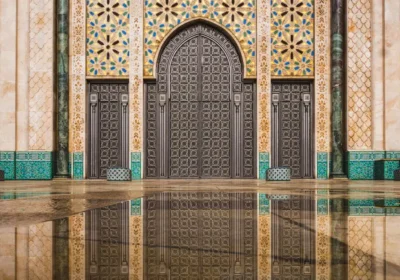
The Hassan II Mosque is the exception to every rule: built over the Atlantic, with a 210-metre minaret, it is one of the very few mosques in Morocco open to non-Muslims. The floor is glass in places — you see the sea beneath you.
Rabat: the most underrated
The capital is quiet, clean and stately — and most people pass it by. A mistake.
The Kasbah of the Udayas, with its blue-and-white lanes above the sea, gives the same feeling as Chefchaouen without the crowds. The Hassan Tower with the Mausoleum of Mohammed V is one of the finest ensembles in the country. And its medina is small, walkable and free of sales pressure.
Essaouira: the Atlantic air
After Marrakech, Essaouira works as a breath. A fortified town on the ocean, with seagulls, fishing boats painted blue and 18th-century walls.
The wind blows almost constantly — which is why it is a kitesurfing destination, and why it stays cool even in August. Its medina is small, flat and impossible to get lost in. The exact opposite of Fez, which is why they pair so well in the same journey.
Tangier: the gateway between two continents
Few travellers think of Tangier, and that is a shame.
It stands where the Mediterranean meets the Atlantic, with Spain visible across the water on a clear day. Fourteen kilometres of sea separate two continents, and you can see it with the naked eye.
The city carries an unusual history: for decades it was an international zone, something between a port, a refuge and a temptation, and writers and musicians passed through and wrote about it. Today it is renewed, but the old medina and the kasbah at the top keep the old character. And the Caves of Hercules, just outside the city, with the opening shaped like the map of Africa.
It is the overnight stop on the seven-day programme, and it works beautifully as a first encounter with the country: Moroccan enough that you know where you are, Mediterranean enough that it will not startle you.
Chefchaouen: the blue city
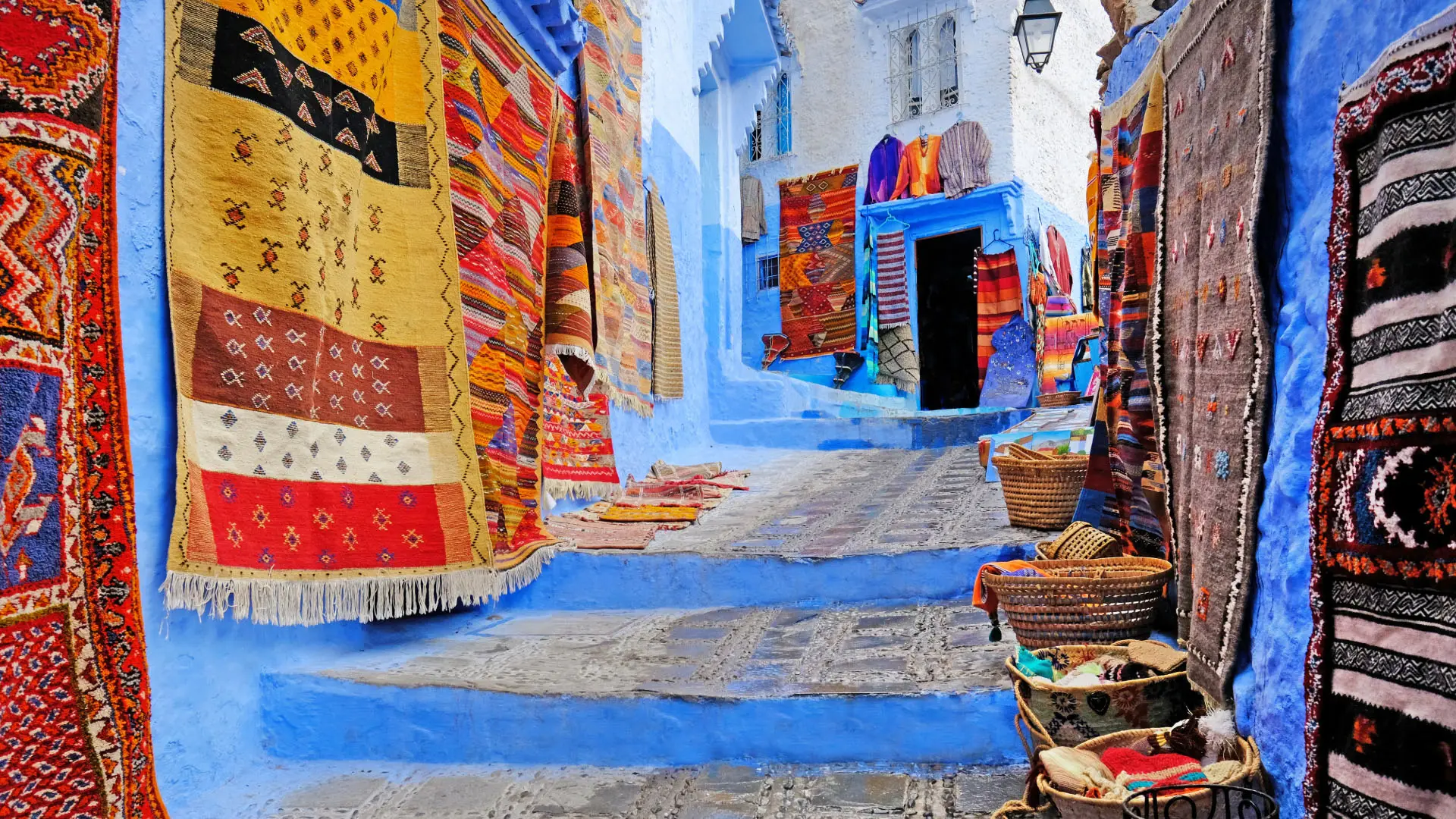
Hidden on the slopes of the Rif mountains, Chefchaouen is one of the most photogenic towns in the world. The houses are painted every shade of blue, from pastel to deep indigo.
In our programmes it is a stop along the route from Tangier to Fez — and that is deliberate. Chefchaouen is small; its centre can be walked in two hours, and after that you start repeating the same lanes. It is a town that gives its best in one full visit.
The honest observation: it has become very popular and the central lanes fill up. What makes the difference is where you go — two or three alleys above Outa el-Hammam square, the crowds thin out abruptly and what remains is the blues, the cats and the women hanging out laundry.
And if you have free time and an appetite for an uphill walk, the Spanish Mosque on the opposite slope gives you the whole town from above — a twenty-minute walk, and the best photograph of Chefchaouen.
Sahara — Merzouga: the experience that defines the journey
No journey to Morocco is complete without the Sahara — if you have the days.
The dunes Erg Chebbi near Merzouga reach 150 metres in height. And the route there is one of the most beautiful parts of the journey — as long as it is not done in one day.
That is why our programmes break the kilometres with an overnight stay in Ouarzazate. It is not an accounting decision; it is the reason you actually see what others pass by through a window.
The Atlas and the Tizi n’Tichka pass, at 2,260 metres, with Berber villages on its slopes.
Ouarzazate and the Atlas Studios — scenes from Lawrence of Arabia to Game of Thrones were filmed here. Morocco’s desert has played Egypt, Jerusalem, Mars.
And more recently Troy: the prologue of the Odyssey by Christopher Nolan was filmed here and at Aït Ben Haddou. We wrote a separate piece on exactly where Nolan worked in Morocco. Entry to the Atlas Studios is included in the price of the eight-day programme.
Aït Ben Haddou, a UNESCO World Heritage monument. A fortified village of clay and straw, built into the hillside above the river. You climb it on foot, and from the top you understand why so many directors chose it.
The Dades Valley with its gorges and palm groves, the next day.
Where you sleep — and why it changes everything
The night in the desert is the moment everyone remembers. Sunset from the crest of a dune, dinner under the stars, absolute silence — real silence, which most people have never heard in their lives.
But this depends entirely on exactly where you spend the night, and this is where it pays to compare programmes before you book.
Most agencies sleep in Erfoud — a town with hotels, but a good few kilometres from the dunes. It means you set out in the afternoon for the sunset, drive back at night, and if you want the sunrise you wake very early to drive again.
We sleep at the Kasbah Jasmina, in Merzouga, right beside the dunes. You walk up to the sunset on foot. At night you step outside and the stars are there, with no city lights. And sunrise finds you already in the desert.
It is the difference between visiting the Sahara and sleeping inside it.
One more practical note: the temperature drops sharply after sunset, even in June. A warm layer is not optional.
Experiences that make the difference
A private dinner with a local family. Moroccan hospitality is like nothing else. One dinner in a local home gives you more than ten restaurants.
Hammam. Not the tourist spa — the traditional one, with black soap and a kessa glove. It has been part of daily life for centuries.
A Moroccan cooking class. Two hours in a market and a kitchen, and you understand the country better than five guided tours.
Sunset on a rooftop. Every city has its own. It is free, and it is one of the best moments of the journey.
The Odyssey film sets. Aït Ben Haddou and the Atlas Studios in Ouarzazate hosted the filming of Nolan’s picture — and both are visited on the eight-day programme. See what was filmed where.
Staying in a riad. Our programmes use hotels, for comfort and consistency with groups. But if you prefer the traditional riads — courtyard mansions of a dozen rooms, inside the medina — we arrange it on request. It has its own charm and its own trade-offs; we will tell you honestly which.
Moroccan cuisine: what you must try
Moroccan cuisine is the result of centuries of influences — Arab, Berber, Andalusian, Jewish.
Tajine. The emblematic dish, slow-cooked in the clay vessel of the same name. Chicken with lemon and olives, lamb with prunes, vegetables with spices.
Couscous. Traditionally eaten on Fridays. If you find yourself in a Moroccan home that day, you know what you will be eating.
Pastilla. A sweet-savoury pie of pigeon or chicken, almond and cinnamon, dusted with icing sugar. Strange on paper, exceptional on the plate.
Harira. The soup of chickpeas, lentils and tomato that breaks the fast during Ramadan.
Mint tea. It is not a beverage, it is a ritual. It is poured from a height so it froths, and it is offered three times. Refusing is impolite — accepting all three is respect.
Practical matters — what people actually ask
Flights. There is no direct flight from Thessaloniki to Morocco. Departures from Thessaloniki go via Athens, on the same international flight. The price difference between the two departure cities is the domestic ticket, nothing else. We say this plainly because we believe you should know it before you book, not at the airport.
There is also a departure from Heraklion, as well as a no-flights programme for those arranging their own way there.
Visa. EU citizens do not need one for stays of up to 90 days. A passport valid for at least six months. More at the official Moroccan tourism site.
Currency. The Moroccan dirham. It is a closed currency — you cannot get it before you leave and you cannot keep it after. You exchange on the spot.
Haggling. In the souks it is the rule, not the exception. In fixed-price shops it does not apply. If you do not enjoy it, you are not obliged — say no and walk on.
Alcohol. Available in hotels and many restaurants in tourist areas, not in traditional ones. It is not consumed in public.
Ramadan. It changes the rhythm — restaurants closed by day, cities alive at night. It is not an obstacle, but worth knowing when you choose your dates.
Dress. Nothing strict for visitors. Covered shoulders and knees at religious sites. Women do not need a headscarf outside mosques.
Temperatures. The Atlas and the desert get very cold at night, even in warm months.
Safety. Morocco is among the safest destinations in North Africa. Ordinary big-city awareness is enough.
Why an organised journey makes the difference here
We do not say this about every destination. In Italy or Spain, an independent trip works just fine. Morocco is different, for three reasons.
The distances are long and the roads demanding. From Marrakech to Merzouga you cross a mountain pass at 2,260 metres and hundreds of kilometres of desert. With proper design, it breaks into two days with an overnight stay and becomes part of the journey. Without it, it becomes an ordeal.
The language and the codes. Arabic and French. English exists in tourism, not everywhere. And there are social codes — when to haggle, when not to, how to decline politely — that no brochure explains.
Access. The family dinner, the hotel in the right part of town, the kasbah beside the dunes instead of the town an hour away — these are not found on platforms. They are found through relationships built over years.
That is why a well-designed organised journey to Morocco does not take away your freedom — it gives you time.
Where to start
If it is your first time and you have five days, the Atlantic axis is the right choice. If you have eight and want to see why everyone talks about the Sahara, take the eight-day programme — and sleep beside the dunes.
And if you are not sure, ask us. We will also tell you what does not suit you.
See all our Morocco programmes
George Gialamas
Founder & Managing Director, Genius Travel