
There is a reason Egypt is on everyone’s list: it is the oldest organised civilisation you can visit. And there is also a reason many people come back tired instead of full: they went with the wrong plan.
A trip to Egypt isn’t difficult. It is, however, a journey of logistical precision: distances, domestic flights, cruise embarkation days, the hours that archaeological sites open and close. When those are solved properly, all that remains is the awe.
This guide is what I would tell you if we were sitting across a table.
How many days you really need
Egypt has three faces: Cairo with the Pyramids, the Nile with the temples of the south, and the Red Sea. How much you see is purely a matter of days.
Five days: Cairo in depth
Our five-day programme, “The Light of the Nile”, is devoted to Cairo and its surroundings — the Pyramids, the Sphinx, the two great museums, Islamic and Coptic Cairo, and a day in Memphis and Saqqara, where it all began. Its fourth day is called “A Night at the Pyramids” — and it is exactly that.
The Light of the Nile, 5 days: departing from Athens · departing from Thessaloniki
Ten to eleven days: the whole of Egypt
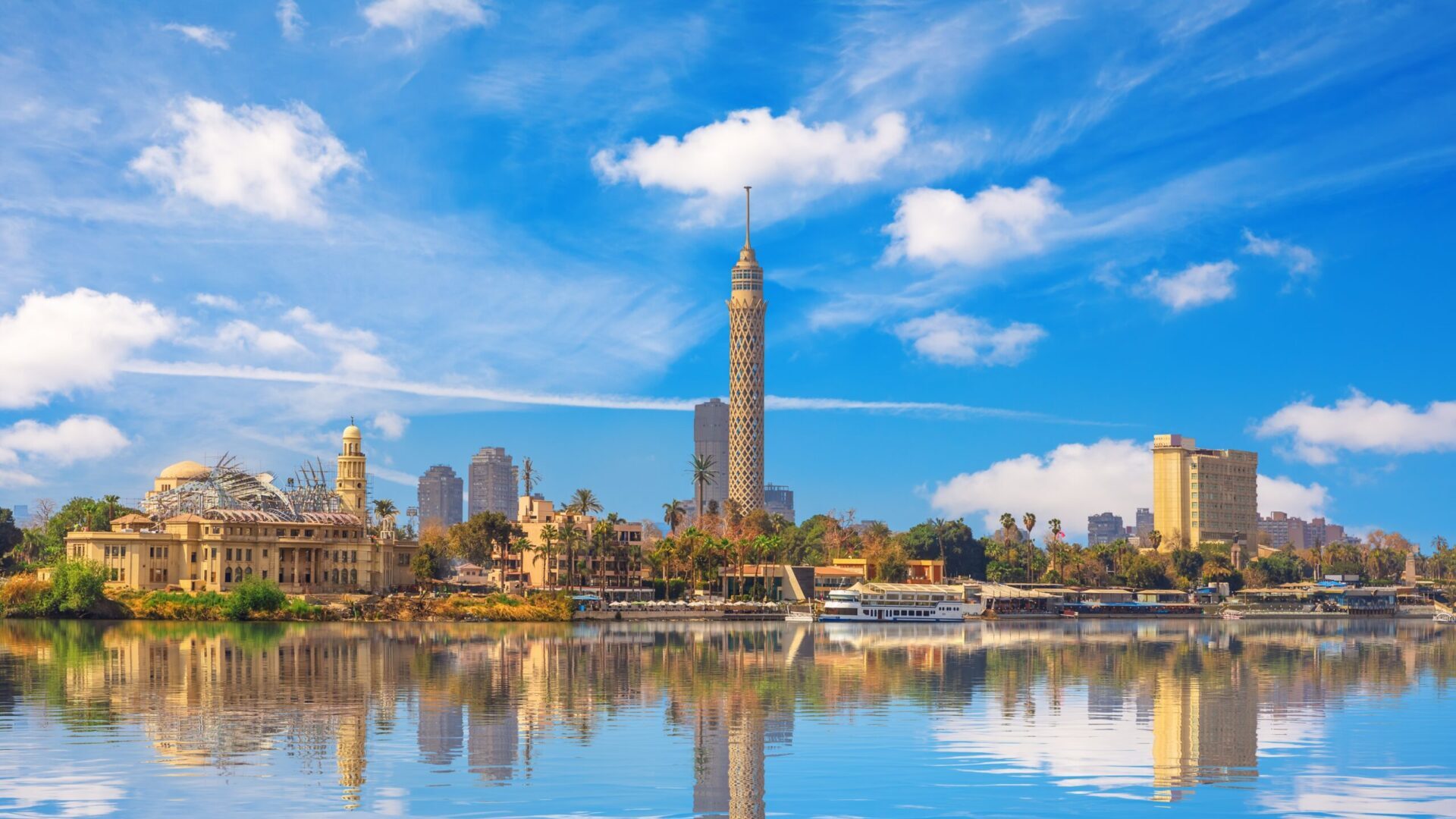
Our new complete programme joins all three faces in one route that flows instead of rushing:
Cairo with the time it deserves — the Pyramids, the Grand Egyptian Museum, the Museum of Egyptian Civilisation, Saladin’s Citadel, Khan el-Khalili, Coptic Cairo. Alexandria as a full-day excursion. A flight south and a Nile cruise for three nights, from Aswan to Luxor. And a finish in Hurghada, on the Red Sea, at an all-inclusive hotel — because after a week of temples and museums, the last days of a well-designed trip are rest, not another transfer.
Departures are tied to the cruise embarkation days — ask us about dates or see all our Egypt programmes.
What not to do: don’t fly all the way to Egypt to see only the Pyramids in a rushed three-day hop, and don’t try to squeeze the cruise into a seven-day programme along with everything else. The Nile needs its nights and Cairo needs its days.
When to travel — the truth about every season
October – April. The main season, and rightly so: 20–28°C, ideal for archaeological sites. December and January are the peak — book early.
May – September. Heat — in Luxor and Aswan often above 40°C. The programme adapts: ancient sites early in the morning, museums at midday. The Red Sea, on the other hand, is at its very best.
Ramadan. The country runs, but the hours shift — and the evenings take on a life of their own. Worth knowing when you choose your dates.
Cairo: the city you never quite finish
The Pyramids — early, and in the right order
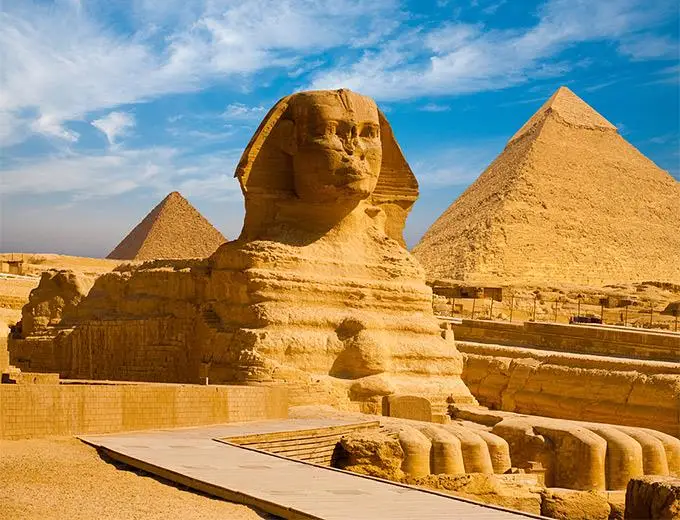
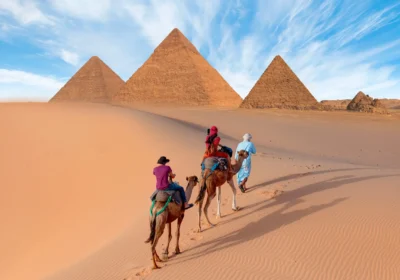
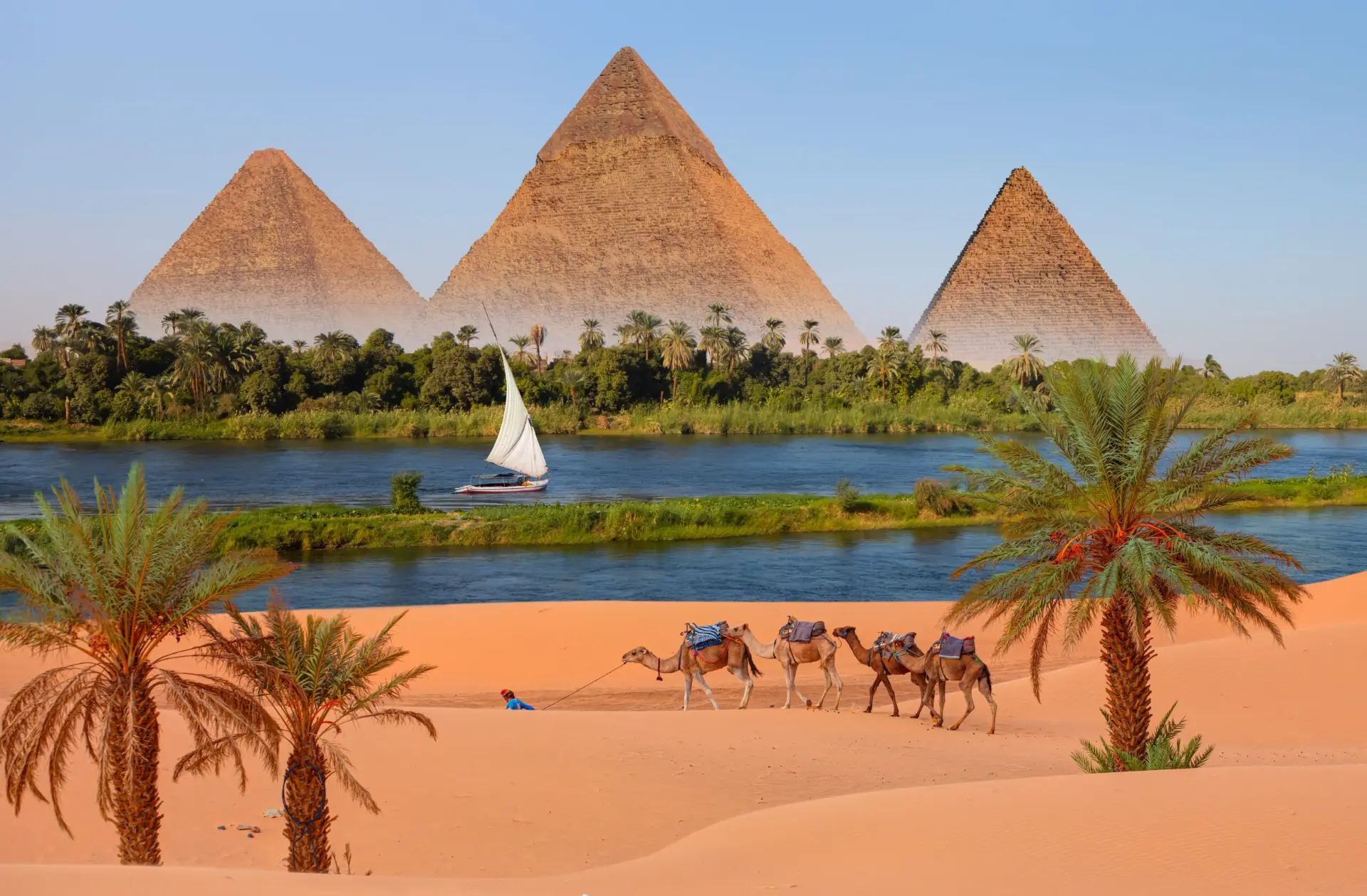
The Giza plateau opens in the morning, and the first hour is why you go with an organised entry: the light is low, the cruise-ship coaches haven’t arrived, and the photograph of all three pyramids from the panorama point is clean. The Sphinx faces the sunrise — literally; that’s why you see it best in the morning.
And yes, you can go inside the Great Pyramid. It’s narrow, hot and empty — there is nothing to “see”. We recommend it anyway: standing in Khufu’s chamber, beneath two million blocks of stone, isn’t a sight. It’s a feeling.
The two museums — and why you need both
The Grand Egyptian Museum (GEM) beside the Pyramids is the largest archaeological museum in the world devoted to a single civilisation — with Tutankhamun’s treasure shown complete in one exhibition for the first time in history, and Khufu’s solar boat. It needs half a day, and you’ll still leave with a list for next time.
The National Museum of Egyptian Civilisation (NMEC) in Fustat holds something no other museum in the world has: the hall of the royal mummies. Ramses II is there. We won’t say more — only that people speak quietly in that room, and not because any sign asks them to.
Islamic and Coptic Cairo
From Saladin’s Citadel, with the alabaster mosque of Muhammad Ali — built to plans that echo Constantinople, by a ruler born in Kavala, Greece — you see all of Cairo out to the Pyramids, when the haze allows.
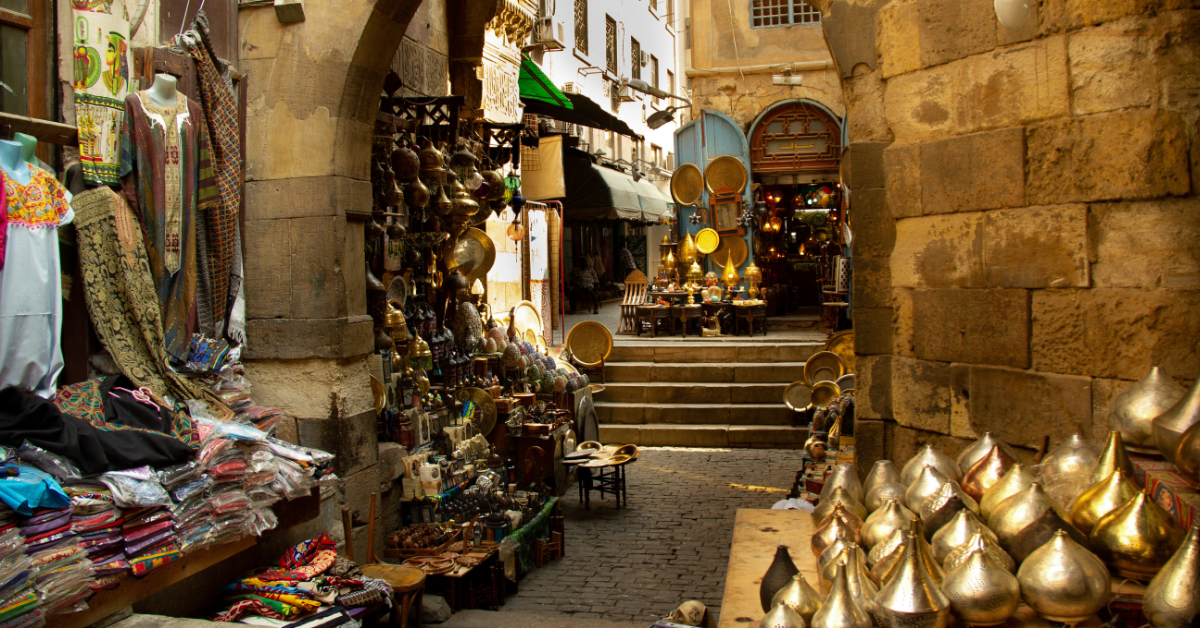
Khan el-Khalili has been a bazaar since the 14th century — spices, copper, silver, lanterns. Haggling everywhere, with a smile. And the historic El Fishawy café, open continuously since 1773, for a mint tea in the middle of the crowd.
In Coptic Cairo, the church of St George — a Greek Orthodox church standing on the Roman fortress of Babylon — and the Hanging Church are reminders that history here didn’t stop with the Pharaohs: it passed through the Romans, the first Christians and Byzantium before Islam arrived. For Greek visitors in particular, it has a familiarity you don’t expect in the middle of Cairo.
Saqqara and Memphis: where it all began
Before Giza there was Saqqara — Djoser’s step pyramid is the oldest large stone structure in the world, the “test tube” from which the perfect pyramids emerged. And Memphis, the first capital of the unified kingdom, with the fallen colossus of Ramses. It’s the day that puts Giza in order — which is why it has its own place in our five-day programme.
Alexandria: the Greek soul of the Mediterranean
Two hours from Cairo, and the air changes — literally. The city of Alexander and Hypatia, of the Ptolemies and Cavafy, is today a Mediterranean metropolis with a corniche right on the waves.
The Bibliotheca Alexandrina, the modern tribute to the lost ancient library, its tilted disc roof turned to the sea. The Qaitbay fortress, built exactly where the Pharos stood — one of the seven wonders, with its stones built into the walls. The catacombs of Kom el-Shoqafa, where Egyptian, Greek and Roman art blend in a way you won’t see anywhere else. And fish by the harbour — Alexandria eats the best seafood in Egypt.
In the complete programme it’s a full-day excursion — enough for the essence, without losing a night from the Nile.
The Nile cruise: the right way to see the south
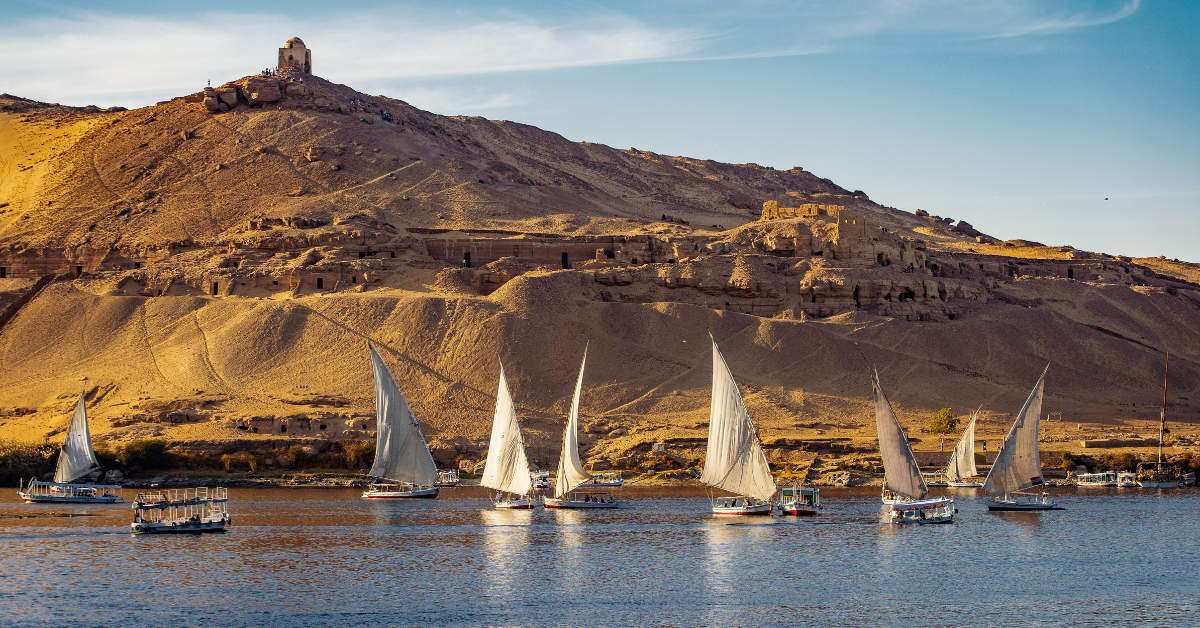
The temples of the south stand hundreds of kilometres apart in the desert — but all of them were built beside the river. The cruise isn’t a tourist luxury; it has been the natural way to travel here for three and a half millennia. You sleep, and your hotel travels for you.
Aswan. Egypt’s most easy-going city, with the Nile at its most beautiful. The temple of Isis at Philae, moved stone by stone to an island to save it from the dam waters. The feluccas with their white sails around Elephantine. And optionally, for those who can face the early start, Abu Simbel — the four seated colossi of Ramses II carved into the rock, three hours south. Tiring? Yes. Does anyone regret it? No one.
Kom Ombo. The double temple — half for crocodile-headed Sobek, half for Horus. Next door, a museum of mummified crocodiles. The visit usually happens at dusk, with the temple lit above the river.
Edfu. The temple of Horus, the best-preserved temple in all of Egypt — with its roof still in place, which is exceptionally rare. You walk in and understand what an Egyptian temple really was: dark, tall, the light narrowing towards the sanctuary.
Luxor. Ancient Thebes, the largest open-air museum in the world. Karnak with its great hypostyle hall — 134 columns, the central ones twenty-one metres tall — which silences even the most talkative. And on the west bank, where the sun set and the underworld began: the Valley of the Kings with painted tombs that have kept their colours for three thousand years, the temple of Hatshepsut set against the cliff, and the Colossi of Memnon guarding what remains.
The Red Sea: the reward
After a week of archaeological awe, the body asks for the sea. Hurghada is the answer — and the reason our complete programme ends there rather than in one more city.
The Red Sea has some of the richest reefs on the planet: coral in living colour and fish you don’t need a diving licence to meet — a mask is enough. A boat trip for snorkelling around the islands, or a desert safari with sunset and Bedouin tea for those who haven’t had enough sand. Or absolutely nothing: an all-inclusive hotel, a sunbed, and the first book of the trip you finally get to open.
Egyptian cuisine: what to try without fail
Koshari. The national dish: rice, lentils, pasta, chickpeas, caramelised onion and a spicy tomato sauce. Sounds odd, works perfectly.
Ful and taameya. The Egyptian breakfast — slow-cooked fava beans, and the local “falafel” made of fava instead of chickpeas, greener and fluffier.
Molokhia. A green soup with garlic and coriander over rice with chicken. Egyptians love it with a passion that can’t be explained — until you try it properly made.
Om Ali. The national dessert: warm “milk pie” with pastry, milk, nuts and raisins. You order one for the table; the table orders a second.
Karkade and sugarcane juice. The crimson iced hibiscus drink, and the juice pressed in front of you on every corner.
Practical matters — what people actually ask
Visa. For EU citizens — including Greek passport holders — the visa is issued on arrival at the airport (around 25 US dollars) or online before you travel. Passport valid for at least six months. On our programmes we walk you through it step by step — it isn’t something to worry about. Other nationalities should check their own requirements.
Currency. The Egyptian pound. Euros and dollars are exchanged easily; keep small notes too.
Baksheesh. Tipping in Egypt isn’t the exception, it’s the culture — small amounts, often. On organised programmes the essentials are taken care of, and for the rest we’ll tell you what’s reasonable so you’re never left wondering.
Safety. Egypt’s tourist routes are among the most protected in the world — tourism is a national priority. The usual big-city awareness applies, nothing more.
Water. Bottled, always. And for brushing your teeth on the cruise, don’t overthink it — just do it.
Dress. Light, comfortable clothing; covered shoulders and knees in mosques and churches. A hat and sunscreen are not optional. In winter, a layer for the Nile evenings.
Photography. Some museums and tombs require a separate photo ticket — your guide will tell you where it’s worth it.
Why an organised trip makes the difference here
If there is one country where we say this without hesitation, it’s Egypt. For three reasons.
The guides. In Egypt, guiding at archaeological sites is done by licensed Egyptologists — and the difference between seeing Karnak and understanding it is exactly that person.
The logistics. A domestic flight, cruise embarkation days, the transfer to the Red Sea, site opening hours — it’s a puzzle we solve before you leave, not one you solve on the spot.
The calm. Egypt is intense — vendors, noise, life everywhere. With a group and someone at your side, the intensity becomes folklore instead of fatigue. You travel with your curiosity open and your stress switched off.
Where to start
If you have five days, Cairo with Saqqara and Memphis is a complete, deep journey — not a compromise. If you can give it ten, do the whole thing: Cairo, Alexandria, the Nile, the Red Sea. It’s the trip you’ll describe to your grandchildren.
And if you’re not sure, ask us. We’ll also tell you what doesn’t suit you.
George Gialamas
Founder & Managing Director, Genius Travel